Saturday, January 15, 2022

The Relevance of Dr. King to the "Critical Race Theory" Controversy -- Temple Emanuel of Maryland's annual Martin Luther King, Jr. Shabbat Service


Since 1987, Temple Emanuel of Kensington MD has been conducting special Shabbat services on the anniversary weekend of the celebration of the birth of Dr. Martin Luther King, Jr., recommitting ourselves to his vision of a multi-cultural Beloved Community and a government based on democratic values.

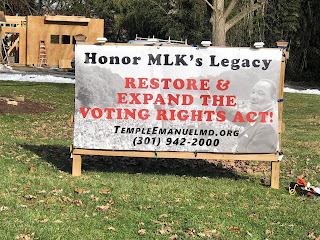
With Dr. King’s legacies on voting rights and the ability to teach the facts concerning the impact of slavery and racism under threat, this year's service was particularly timely. Temple Member Sunil Dasgupta, Director of the Political Science Program for the University of Maryland/Baltimore County at the Universities at Shady Grove, spoke on The Relevance of Dr. King to the "Critical Race Theory" Controversy. The service may be viewed at

The program for the service, including the readings by other Temple members, is copied below, followed by the text of Sunil's excellent, incisive, thought-provoking presentation.


MARTIN LUTHER KING, JR., SHABBAT SERVICE

TEMPLE EMANUEL, JANUARY 14, 2022


The Relevance of Dr. King to the “Critical Race Theory” Controversy


Officiants:  Rabbi Mark Levine and Cantor Lindsay Kanter


Readers:    Sali Greeley, Ian DeWaal, Glenn Northern, Marilyn Urwitz, Marjorie

                   Kitzes, Erika Sussman, David Fishback, Gus Bookbinder


Introduction of Speaker:  Candace Groudine


Speaker:  Professor Sunil Dasgupta, Director of the Political Science Programs for

                 the University of Maryland Baltimore Campus at the Universities at Shady

                 Grove


Board Representative:  Jen Goldschmidt


(Thank you to Ian DeWaal, Marla Banov, and Ken Karbeling for designing and producing the banner and to Sandy Fleishman for designing and producing the flyer)


READINGS


PART I


This evening, we recall these words of Dr. Martin Luther King, Jr.


Dr. King's often quoted from Amos (5:24), "We are not satisfied, and we will not be satisfied, until justice rolls down like waters and righteousness like a mighty stream."


His vision was rooted in a faith that right would prevail: "The arc of the moral universe is long, but it bends toward justice."


But he also knew that only through the work of our own hands would the world become a better place:  


"Human progress is neither automatic nor inevitable. . . .  No social advance rolls in on the wheels of inevitability; it comes through the tireless efforts and persistent work of dedicated individuals, who are willing to be co-workers with God."


This evening, we give thanks to all those who have taken these words to heart.


Dr. King recognized that our goal could not only be the end of segregation laws and the enactment of laws barring discrimination -- that we must go well beyond that: 


"We are simply seeking to bring into full realization the American dream -- a dream yet unfulfilled. 


“A dream of equality of opportunity, of privilege and property widely distributed; a dream of a land where men no longer argue that the color of a man's skin determines the content of his character; the dream of a land where every man will respect the dignity and worth of human personality -- this is the dream.”


 “When it is realized, the jangling discords of our nation will be transformed into a beautiful symphony of brotherhood, and men everywhere will know that America is truly the land of the free and the home of the brave."


We also remember that the journey to the Promised Land is far from finished, and that many obstacles remain.


PART II – VOTING


Integral to that Journey is the presence of fair and free elections.  Dr. King understood the necessity of using the ballot to advance justice.  Speaking in late October 1964, he reminded his listeners that: “Each of us [who is able] has a moral responsibility to participate” in the upcoming Presidential election.  He went on to speak words that have as much, if not more resonance today, 58 years later.


“We stand in one of the most momentous periods of human history.   In these days of emotional tension, when the problems of the world are gigantic in extent and chaotic in detail,

. . . people of this nation must decide whether they want America to remain true to the great words of the Founding Fathers: ‘We hold these truths to be self-evident, that all men are created equal. That they are endowed by their creator with inalienable rights, and that among these are life, liberty, and the pursuit of happiness.’  We must decide whether those words will be firmly etched into the structure of our nation, or whether we will allow our nation to be relegated to a second-rate power in the world with no moral voice.  We must decide whether America will take the high road of justice and peace and compassion for the poor and underprivileged, or whether the nation will tread the low road of man’s inhumanity to man, of injustice, of short-sightedness.”


The next year, 1965, Congress passed and the President signed the Voting Rights Act.  And for the first time, America took a major step toward becoming a multi-racial democracy.   


The struggle for the vote was not over. Shortly before his assassination in 1968, Dr. King wrote that powerful Senators were interfering with the implementation of the Voting Rights Act. “The power and moral corruption of these Senators remain unchallenged, despite the weapons for change the legislation promised to be.  Reform was thwarted when the legislation was inadequately enforced.”


In the years that followed, much progress was actually made.  But in 2013, the Supreme Court eviscerated the Voting Rights Act, and then, last year, further weakened the Act by disregarding the plain objective of the provisions that were not overturned in 2013. And now, at least half of the United States Senate stands idly by while the forces of White Supremacy, enabled by the weakening of the Act’s protections, seek to turn us back.


Dr. King urged that we work toward becoming a diverse, Beloved Community.  We have not yet reached that Promised Land, and, indeed, we are in great danger of being returned to the desert.  The work of Dr. King, the 20th Century Moses, is under attack and is unfinished.


PART III – THE HOUSE WE ALL LIVE IN


Dr. King presented to us this homily:


"Some years ago a famous novelist died.  Among his papers was found a list of suggested plots for future stories, the most prominently underscored being this one:  'A widely separated family inherits a house in which they have to live together.'"


 "This is the great new problem of mankind.  We have inherited a large house, a great 'world house' in which we have to live together -- black and white, Easterner and Westerner, Gentile and Jew, Catholic and Protestant, Muslim and Hindu -- a family unduly separated in ideas, culture and interest, who, because we can never again live apart, must learn somehow to live with each other in peace."


Pulitzer Prize winning author Isabel Wilkerson, in her book Caste, provides a take on this metaphor, which takes us deeper into the problems posed by us all living in this house.


“We in the developed world are like homeowners who inherited a house on a piece of land that is beautiful on the outside, but whose soil is unstable loam and rock, heaving and contracting over generations, cracks patched but the deeper ruptures waived away for decades, centuries even.


“Many people may rightly say, ‘I had nothing to do with how this all started.  I have nothing to do with the sins of the past.  My ancestors never attacked indigenous people, never owned slaves.’


 “And, yes.  Not one of us was here when this house was built. Our immediate ancestors may have had nothing to do with it, but here we are, the current occupants of a property with stress cracks and bowed walls and fissures built into the foundation. We are the heirs to whatever is right or wrong with it.  We did not erect the uneven pillars or joists, BUT THEY ARE OURS TO DEAL WITH NOW.


“And any further deterioration is, in fact, on our hands.”


Our ability to deal with this broken house is America’s moral challenge in the 21st Century.  We can only repair this house if we face up to its defects.  One of those defects, and one that will be discussed by this evening’s speaker, is the role of law, social norms, and longstanding institutional structures in perpetuating racism and inequality.  As James Baldwin wisely observed, “Not everything that is faced can be changed.  But nothing can be changed if it is not faced.”  Dr. King himself observed that America’s moral vision had been clouded by “a poisonous fog of lies.” We must face the whole truth of our past and our present if we are ever to make true progress. 


 PART IV – THE ROAD FORWARD

Dr. King’s words, actions, and vision, like the Exodus story, must be told to every generation, and must be seen not just as history, but as a lesson for the present and the future.  Dr. King’s teachings were a way of stating the Jewish concept of Tikkun Olam – humankind’s effort to repair the world. 


They are lessons for us all. 


It is our duty, our responsibility to continue the work.  These are, once again, fraught times.  But as the Torah so often tells us, “Be Not Afraid.” 


Dr. King taught us, “if you can’t fly, then run.  If you can’t run, then walk.  If you can’t walk, then crawl.  But by all means, keep moving.”


Tonight, we rededicate ourselves to “keep moving.”


MLK Shabbat Speech at Temple Emanuel, Kensington, Maryland

Sunil Dasgupta

January 14, 2022


 Thank you, Candace. Shabbat Shalom!


Every year at this time, congregations across the United States celebrate the life and work of Dr. Martin Luther King, Jr. Dr. King represents the possibility that we can overcome the troublesome, often horrific, origins of the United States by appealing to the idea that we are all equal in the sight of a higher power, and that a vital part of our mission on earth is to create a Beloved Community of all people, not just some. We celebrate this possibility at Temple Emanuel, not just in the middle of January every year, but hopefully every day.


Now, I am neither African-American nor an expert on the life and legacy of Dr. King, so what am I doing here? It turns out that I know David Fishback, who has organized the Martin Luther King Shabbat at Temple Emanuel since 1987. I want to congratulate you David, the Reform Judaism Movement more generally, and past and present members of Temple Emanuel for holding up the light that Dr. King shone more than 50 years ago.


I ran for the Montgomery County Board of Education in November 2020. The campaign was an incredible experience, rich with learning and full of new friends and fellow travelers. Perhaps the most far-reaching insight I gained, however, seemed to put Dr. King’s vision of a Beloved Community to a test.


As part of the campaign, I had championed school boundary change to help integrate our schools and thereby achieve equity, which seemed to me something everyone could get behind. School integration was the law of the land since the Brown decision in 1954. And no less than Dr. King had pushed for integration as the solution to the problem of racial discrimination and especially so in schools.


I was opposed by anti-boundary change folks of course, but what surprised me was the lukewarm response to the idea from African-American groups and leaders.


Once the extent of the school boundary controversy became evident, the NAACP Parents Council in Montgomery County would talk about it, but only if pressed. The Black and Brown Coalition for Educational Equity and Excellence sidestepped the boundary change controversy to focus on what they thought was important: Black and Latino students were being left behind even when a school as a whole did well. Integration, which was expected to produce education equality according to Dr. King’s prescription, was in fact failing.


The pandemic pushed the school boundary controversy to the side, but the puzzle of how and why African-Americans had become ambivalent about school integration stayed with me beyond the election. I wondered whether this was a rejection of Dr. King’s integrationist vision, of a Beloved Community?


This question led me to find a history that is known eclectically, by those who have taken civil rights courses in college or read about civil rights on their own, but it is not part of the base knowledge of American history we teach and learn in public schools. Civil rights history in public school curriculum remains frozen at the victory of the Voting Rights Act in 1965. Then, we acknowledge Dr. King’s assassination in 1968. But after that, nothing. It’s almost as if race disappeared as a factor in American life.


 But, of course, civil rights history had evolved.


Twelve years after Dr. King’s killing in Atlanta, Derrick Bell, a former NAACP Legal Defense Fund lawyer who had worked with Thurgood Marshall on the Brown v. Board of Education, wrote a groundbreaking article that argued that integration itself had failed. Rather than bring equality in education, integration and its benefits were ephemeral. Bell described the civil rights victories as fleeting moments of interest convergence in white America, the result mainly of global criticism of America’s race problem in the context of the Cold War.


Bell later described the situation as the permanence of race and racial discrimination in American social and political life. In other words, we could never really be post-racial. On the face of it, this conclusion went against Dr. King’s strong belief in integration, not only as the Beloved Community, but also as an instrument for uplifting Black lives in America. Bell, for example, favored “model all-Black schools” where the particular needs of African-American children could be met.


Bell’s student Kimberlé Crenshaw used these beliefs to coin the term Critical Race Theory.


Critical Race Theory lingered on the fringes on academic thinking for decades before coming to notice more widely within the Black community by those disappointed in the presidency of Barack Obama to deliver Black advancement. It turned out even having a Black president didn’t help. The problem was deep, it was structural, baked into the American creed.


In line with this thinking, Ta-Nehisi Coates in a 2014 article in The Atlantic called for reparations not just for the racism of the past, but of continued racism well into the 2008 financial crisis.

“It is as though we have run up a credit-card bill and, having pledged to charge no more, remain befuddled that the balance does not disappear. The effects of that balance, interest accruing daily, are all around us.”

Coates chronicled at length how predatory racism, backed by government policy, had cheated black families of their homes and wealth.


And Critical Race Theory itself penetrated into public discourse even later, in conjunction with the New York Times 1619 Project which reintroduced the history of slavery into popular discourse, not because it was being taught in schools.


I came to this history with my own baggage. Growing up in India, I had read Alex Haley’s biography of Malcolm X even before I had read the “I Have A Dream” speech. I knew there had been an internal debate within the Black community over the promise of integration, which Dr. King espoused, and the Black separatist thinking of Malcolm X. It had seemed to my naïve mind that Critical Race Theory was closer in its thinking to Malcolm X than it was to Dr. King.


As I investigated more, I found that the updated civil rights scholarship downplayed the differences between these giants. In 1972, James Baldwin wrote in Esquire magazine: “By the time each met his death, there was practically no difference between them.”


If Baldwin was right, where was the evidence? I sought to find it Dr. King’s last book, published in 1967, Where Do We Go From Here.


In the book, Dr. King writes that the first phase of the civil rights movement--from Selma to the Voting Rights Act--was over, and through the rest of the book, he explains how the struggle had to move on to income equality, housing equality, education equality, and peace. Moving on from attacking white supremacy, Dr. King targeted the structures of oppression, including capitalism and war, and, by the time you reach the appendix he is offering policy alternatives in minute detail that you’d think he was considering a run for the school board: use nonprofessional aides to reduce class size; build big school complexes to capture economies of scale; bring greater family input into schools.


Commenting on the education expert James Coleman’s report to President Lyndon B Johnson about the importance of family background in education outcomes, Dr King wrote:


“Whatever pathology may exist in Negro families is far exceeded by this social pathology in the school system that refuses to accept a responsibility that no one else can bear and then scapegoats Negro families for failing to do the job. The scattered evidence suggesting that family life is important in education progress provides only partial support for the rationalizations of educators; for family life explains only a small portion of learning difficulties.  The job of the school is to teach so well that family background is no longer an issue."


Teach so well that family background is no longer an issue.


Dr. King had called for differential investment in the education of black and poor children, which came, but anemically. Progress won in one way, via school integration, has been lost in another way, in housing and employment and the school to prison pipeline.


 So, what lessons can we draw from all this history?


First, while Dr. King and Critical Race Theory may on the face of it differ over their integrationist and separatist approaches, they are agreed on the problem: the promise of integration has vastly differed from its practice.


In the Montgomery County public schools, for example, we maintain three distinct levels of teaching of high school courses: Advanced Placement and International Baccalaureate (AP and IB) at the top, followed by Honors, and then on-grade. Black and brown students are tracked to on-grade courses while AP/IB courses are more likely to have white or Asian students. In Critical Race Theory, this is systemic racism. But because we have proclaimed integration, this reality and history remains invisible.


We have always wanted to see integration and segregation as opposites, a dichotomy, where one is vanquished and the other ascendant, and we want to see this battle play out in Dr. King’s life and the impact he had on our polity. In reality, however, integration and segregation have co-existed. There is no bright line in between. He won some battles. We lost some after he was gone.


The simultaneous and often shifting venues of segregation and integration means that we make progress and fall behind within our lifetimes. Put another way, this is a fight we fight every day. We may never know how Dr. King’s thinking might have evolved had he lived longer, but I think he would agree that the struggle continues.


Second, what the Critical Race Theory controversy really shows to me is how badly and for how long we have neglected the study of history, including freezing Dr. King in his “I Have a Dream” moment, and then missing the emergence of Critical Race Theory as a revitalizing school of thought.


Three decades ago, in the early 1990s, in the heady days of Cold War victory, we proclaimed the end of history. To be fair, it was the phrase coined by political scientist Francis Fukuyama; so we political scientists bear responsibility here.


The idea of the end of history and the rise of new technologies in computing and communications led us to shift of our education resources to the learning of science and technology and we saw a cultural shift in education and the coinage of another term, STEM, science, technology, engineering, math. Those who studied history were apparently going to be consigned to low-paying jobs in fast food restaurants.


The neglect of the study of history was most acutely felt in K-12 public education where curriculum is rigid, and teachers have less freedom than someone like me who teaches at a university. Graduate education in history continued to grow through this period in ideas and in magnitude. K-12 teaching of history was denied resources and talent was diverted away to more so-called productive areas. There simply was not the time and space during the school day to keep up with a changing historiography.


I host a cheeky local podcast called “I Hate Politics” and, in one interview, a Montgomery County Council member said to me that he wanted county residents to know who had lived in this area in the past. He lamented that we couldn’t get equity unless we knew this history. I asked him if he had supported expansion of the study of history?


I got crickets for an answer, but to be fair, he is hardly alone. We want biotech, not the history of biotech, which includes the story of Henrietta Lacks, the black woman subjected to countless medical experiments and surgeries without her consent. We want great schools but look away from a history of unequal education that continues to persist. I have seen an official report of the so-called achievement gap in MCPS dated 1988. 34 years. [Since the speech, I have seen an MCPS achievement gap report from 1983.]


We have a controversy over the Critical Race Theory not because our public schools are already teaching this history, but because they are not.


Dr. King’s untimely death at the age of 39 left us to speculate about how his thinking would have evolved as he aged; and, in death we sanctified him as an American saint, which has meant we use and misuse his name as a totem in all kinds of political battles including now over Critical Race Theory.


To me, the relevance of Dr. King to the Critical Race Theory controversy is not merely about speculating on what he might have said had he lived longer, but in highlighting the costs of miseducation, of an outdated curriculum on civil rights, and the neglect of the study of history itself, and consequentially, in my view, the continued achievement gap in public schools.


The Council member I talked to was right. Unless we know and acknowledge this history, especially in our schools, we are not fixing anything. I urge you to join me in asking that our public schools prioritize and correct the teaching of history.


Tuesday, December 21, 2021

Profiles in Cowardice

 Ben Franklin famously told a citizen in 1787 that the Constitutional Convention had fashioned “a Republic, if you can keep it.”

Nearly nine years ago, Republican politicians, having just lost to Obama/Biden in the Electoral College, floated the idea of, in the future, choosing electors by Congressional District. If that had been done in 2012, Romney/Ryan would have won the Electoral College, even though they lost the popular vote by 3.5 million votes. See https://www.washingtonpost.com/opinions/retaining-popular-legitimacy/2013/01/28/eaf15e24-673c-11e2-889b-f23c246aa446_story.html

This idea quickly faded, presumably because Republican politicians were capable of shame and had some respect for majority rule. They chose to keep our democratic republic. 

Four years later, in 2016, Republican nominee Donald Trump won the Electoral College, even though he lost the popular vote by nearly 3 million votes. https://en.m.wikipedia.org/wiki/2016_United_States_presidential_election  (This was the third consecutive presidential election in which the popular vote was won by the Democratic candidate.)  

Having tasted the blood of minority victory, Republicans the got upset in 2020, when they lost the popular vote by 7 million and lost the Electoral College. So now they want to subvert the possibility of majority rule by voter suppression activities and allowing gerrymandered Republican state legislatures to overturn the popular will. 

In other words, they no longer care about keeping a democratic republic. 

And now two nominally Democratic Senators stand in the way of enacting federal legislation which could protect majority rule.  Senators Manchin and Sinema need to look into their consciences and their souls and decide whether they want to go down in history as the two Democratic Senators who were, in effect, collaborators with an opposition party gone mad.  

Similarly, the handful of Republican Senators who were once considered principled states-persons who, when necessary, would put principle above party, must decide whether they wish to go down in history as characters in a sequel to Senator John F. Kennedy's book, this one to be entitled Profiles in Cowardice. 

Thursday, December 16, 2021

General Clark was wrong, and the Maryland General Assembly was right, on gerrymandering

On December 4, 2021, retired General Wesley Clark published an opinion piece the Washington Post urging the Democratic-controlled Maryland General Assembly to refrain from gerrymandering its Congressional districts, notwithstanding larger scale gerrymandering going on Republican states around the country.  I wrote a letter to the Editor taking exception to Gen. Clark's suggestion:

Like the proverbial generals who are always fighting the last war, retired Gen. Wesley K. Clark urged Maryland to lead on resisting gerrymandering in the upcoming redistricting. But Gen. Clark is fighting a war that was lost on June 27, 2019. On that date, the Supreme Court ruled 5 to 4 that the court would not step in to stop partisan gerrymandering, no matter how coarse. 

Sixty years ago, the Supreme Court saved democracy in America by fashioning the one-person, one-vote standard for legislative and congressional districts. This time, the court declined to act to save American democracy. With the coarsest congressional gerrymandering now occurring in large red states such as Texas, Ohio and Florida, for Gen. Clark to urge that relatively small, blue Maryland act as if the court had set legally enforceable standards of fairness is akin to unilateral disarmament. One would think Gen. Clark, as a former NATO supreme commander, would understand the risks of unilateral disarmament.

David S. Fishback, Olney

On December 12, it was published, along with three similar letters. See here.  

I am proud of the members of the Maryland General Assembly who successfully chose not to unilaterally disarm.

Wednesday, November 17, 2021

Standing up and fighting back


STANDING UP AND FIGHTING BACK
A report on the front page of the Nov. 17 Metro Section in the Washington Post reminds us that when parents and students stand up to the “book burners,” Board of Education members discover their backbones – or are given important positive reinforcement to continue to engage in thoughtful educational practices.
This story came just days after a Nov. 14 national news article in the Post carried a disturbing headline (“Conservative school board wins may dampen racial equity efforts”). But the news in that article also reminds us that when parents and students refuse to be beaten down by the screaming, progress can continue.
The Nov. 14 article recognized that while in most recent school board elections “conservatives” lost, “many observers argue that the victories these conservative candidates did notch, and the intense heat the races generated, will have ramifications nationwide.”
But only if we do not stand up to them. The Nov. 14 article closes with this description of what occurred in a town in Connecticut:
“In 2020, the seaside community of Guilford, Conn., reckoned with the murder of Floyd by a White police officer in Minneapolis by implementing more diverse perspectives into the school curriculum and changing the school’s nickname, the Indians.
“As this was unfolding, some students expressed confusion and frustration talking to their parents about the complex issues around race, gender and history that were being addressed in the classroom, said Guilford resident Arnold Skretta, an attorney who was not on the school board at the time.
“Educators and the school board emphasized to families that critical race theory was not being taught in the classroom, but some parents and officials didn’t believe them, accusing the district in a Zoom forum of trying to make people of color feel more welcome ‘at the expense of White Judeo-Christians,’ Skretta said.
“’At that point, it was blatant, overt racism,’” said Skretta, 42.
“Five conservatives were already running for the school board, having ousted three more traditional Republican school board members in the GOP primary in September. Skretta had tracked their rise and joined a group of Democratic and independents to run against them.
“The conservatives drew national interest and money to their race, appearing on Fox News several times, but last week, they lost by 2-to-1 margins.
“Skretta credited high turnout and said he could not have won without significant voter engagement. He hoped that could be a blueprint for races elsewhere.
“’What happened here in Guilford is the consequence of a town getting engaged,’ he said. ‘Democrats can’t let the right wing weaponize school boards.”’
When we stand up, we win. If we cower or give up, we will lose – as will our children and grandchildren

Wednesday, November 3, 2021

Beware of any "conventional wisdom" that Glenn Youngkin is a harbinger of a kinder and gentler Republican Party than the Party of Trump


        Before the "conventional wisdom" solidifies into a trope that Glenn Youngkin is the future of the Republican Party because he is "conservative" without being Trumpy, let's remember the core of each man's campaign for their first political office.

        Trump launched his campaign by asserting the lie -- with all its racist overtones -- that Barack Obama was born in Kenya.  In so doing, he brought into the Republican mainstream the proposition that "real" Americans -- i.e., White Americans --  were under threat from a Black person in the Oval Office who was not a true American.  Trump kicked over the rocks which previously had covered up so much racism, based not just on hate, but also on fear of displacement.

        Youngkin based so much of his campaign on another lie, a lie which went directly to a racist appeal based on hatred and fear:  That "Critical Race Theory" was being taught in the public schools and that it endangered White children because it would make them feel bad and, inferentially, would embolden non-White children to hate White children. https://davidfishback.blogspot.com/2021/10/the-critical-race-theory-controversy.html It was a lie on both counts, and someone as educated and worldly as multi-millionaire former Carlyle Group CEO Youngkin had to know this.  But he was perfectly willing to demagogue the issue to achieve power.  

         So let us not forget that Glenn Youngkin as a politician is essentially a Donald Trump with better manners.  Playing on racial fears of White Americans has been a tactic -- often a successful tactic -- with a long and sordid history in the American story.  And it has always been a destructive tactic, which brought us to Civil War in the mid-1800s and, until the mid-1960s, wiped out most of what Abraham Lincoln and Frederick Douglass hoped to achieve at the end of that war.  The Republican Party strategy now is to win and maintain power by destroying the Second Reconstruction begun with the mid-20th Century Civil Rights Movement.  

        Glenn Youngkin is not only part and parcel of that strategy, but is a dangerous practitioner of it.  And perhaps more dangerous than Trump, because he is not so transparent. 

        Do not be fooled by what may become a media trope of "moderation" in the coming weeks and months.  

Tuesday, November 2, 2021

2007 Bethesda Magazine: "Minority Retort- How did so few people create such a ruckus over the county's new sex-ed curriculum?"


For comparison with the article on LGBTQ+ matters in the Nov.-Dec. 2021 edition of Bethesda Magazine at pp. 156-162 (See here), take a look at its  instructive article by Eugene Meyer in its Sept./Oct. 2007 edition, discussing Attorney John Garza (who is suing MCPS in the litigation referenced in the new article) and his organization, Citizens for a Responsible Curriculum.  As far as I can determine, it was never posted on-line, but below are the pages from the print edition, followed by links to a transcript of the News Talk program referenced several times in Mr. Meyer's article (and my comments on the article, sent to some of my Teachthefacts.org friends:


"Minority Retort" from Bethesda Magazine (Sept./Oct. 2007) on the Montgomery County Health Education Controversy


Here are links to the transcript of the New Talk discussion I had with John Garza in May 2007, courtesy of Teachthefacts.org, Jim Kennedy, and Chris Grewell.
http://vigilance.teachthefacts.org/2007/05/newstalk-transcript-first-part.html


Sent: Tue, 28 Aug 2007 12:21 pm
Subject: Bethesda Magazine
All:
            On Sunday, the Sept/Oct. issue of Bethesda Magazine hit the newstands in Montgomery County.  In it, there is an article by Eugene Meyer entitled "Minority Retort:  How did so few people create such a ruckus over the county's new sex-ed curriculum?"   The article will not likely be on line until November, so I think there would be a serious copyright problems if it were to be posted on public web sites.  (The magazine is only 3 years old, and I suspect they would be very sensitive to such issues.  I know I would be were I its publisher.)

            The article has a pretty accurate description, as far as it goes, of what has been going on the last few years.  I see a few errors, but none are significant to our litigation concerns.  If you are interested in the atmospherics, however, read on.

             1.  While Meyer says I am 60, that is not yet true. I will not be 60 until mid-autumn. Sixty, hmmm. Well, as Satchel Paige said, "Age is mind over matter. If you don't mind, it don't matter."

             2.  John Garza is quoted as saying that I told him I am proud of my son who went to Princeton. A calumny. One of my sons went to Yale (and then Harvard Graduate School of Education), the other went to Penn -- Princeton's arch-rival. Should I demand a correction? :)

               3.  The Scopes Trial was in 1925, not 1924.  1924 is only an interesting date for Washingtonians because it is the only year a Washington baseball team won the World Series.  Perhaps that is what Meyer was thinking about.

              4.  Meyer also reports that Garza told him that he changed his mind about his suggestion that we have lunch and discuss our theological differences, saying that "I dont want to waste his time if he [Fishback] thinks he's going to save me." I found that curious, because I wrote to Garza saying I would be happy to continue our chat, as long as he did not think he was going to save ME. I have no illusions about changing John Garza's mind and heart, but it is always useful to learn other more about other people's perspectives.

              5.  The article quotes Garza as e-mailing the following to Meyer:  “I want to correct something David F. said a while ago.  God has never talked to me.”   Here, in fact, is the direct quote from the e-mail I sent to Meyer describing our post-NewTalk chat on May 1 (which I cc’ed to Garza): “John told me after the program that he personally does not care what individuals do with their lives, but for him, ‘If God tells me to walk on the left side of the road, I walk on the left side of the road.’  (John, if I have that quote wrong, please correct me.)”

 If Garza felt the need to clarify, fine.  But  he did not deny the quote and he did not have the courtesy to copy me with the e-mail.  Of course, this is typical of CRC tactics.  On March 29, 2007, I sent a letter to the State BOE in support of the MCPS decision and providing information on the AMA/AAP/APA positions on matters of sexual orientation – a letter I cc’ed to Garza.  Garza responded to Meyer,  but did not cc me.  I only found out about the letter several weeks later when it showed up on the CRC website.  I mentioned this to Garza after the NewsTalk show, and he blamed it on his secretary.  (This is lawyer talk for “the dog ate my homework.”)

              Of course, the theological exchanges I had with Garza are irrelevant to the litigation issues. 

               6.  As interesting as the main article is, I would principally recommend reading the side-bar interview with a health education teacher at B-CC High School. I am glad we have such teachers.

David

Friday, October 29, 2021

The Critical Race Theory "Controversy"


In recent months, right-wing groups have attacked the alleged use in our schools of "Critical Race Theory," using it as a cudgel to inflame people and to prevent the teaching of basic historical facts and to suppress discussion of the significance of those facts. This is part of an effort to agitate and excite its base to get them to the polls and school board meetings in support of their issues more broadly.  They assert that Critical Race Theory is a doctrine that people  “should view everything through the lens of race and then pit them against one another.”[1] 


But this is NOT what Critical Race Theory is.  Rather, it is  a framework which seeks to understand the impact of race in America. It is a graduate level academic construct focusing on the proposition that, from the beginning of the European migration to what is now the United States, racism has been so intertwined with American law and society that they cannot easily be disentangled. Critical Race theorists have drawn such conclusions based on their assessment of historical and current facts. Nowhere is Critical Race Theory taught as the official core doctrine of American history in our primary and secondary schools; but, one would hope that the kinds of facts that underly it are presented in an age-appropriate manner.


Kendall Thomas is the co-editor of Critical Race Theory: The Key Writings That Formed the

Movement.  He observes that the theory maintains that racism “does not have to define our

future if we have the will and the courage to reckon with it.”  Rather than

encouragingWhite people to feel guilty, Thomas explains, Critical Race

Theorists aim to shift focus away from individual people’s bad actions 

and toward how systems uphold racial disparities. Thomas concludes

that “Critical race theory is an effort really to move beyond the focus on

[simply] finding fault by impugning [people’s] racist” animus and the like,

and instead looking “at the ways in which racial inequality is embedded

in structures in ways of which we are very often unaware.”[2]  


Nevertheless, right-wing groups incorrectly assert that “Critical Race Theory” is

a doctrine which asserts that all White people are inherently, unavoidably,

and irretrievably racist, and that this doctrine threatens to take over education in

our country.[3] They lump the theory together with the historical facts surrounding 

race in America. They oppose mention in our classrooms of historical facts and

current conditions that might make White children feel bad.  Their goal is to

suppress uncomfortable facts about our shared history.


Daniel Patrick Moynihan famously said that “everyone is entitled to his own

opinion, but not his own facts.”  But the attack on “Critical Race Theory”

is an effort to impose a whitewashed version of America, by suppressing

discussion of relevant facts.


There are a variety of theories that seek to make sense out of the facts. One

may be summarized by Chief Justice Roberts’  2007 statement that "the way

to stop discrimination on the basis of race is to stop discriminating on the

basis of race"[4] ; this is a proposition that past evils are totally a thing of

the past, that any legacies of human slavery in America have zero impact

on our society today. 


Recent attacks on “Critical Race Theory” are, at best, nothing more than

attempts to ensconce “Roberts RaceTheory” as the official doctrine of

American education, holding as irrelevant any possible impact of human 

slavery and its legacy on 21st Century America.  At worst - and most of

the time they are “at worst” – they are attempts to whitewash the facts of

our history. For example, that is precisely what the recent Texas law limiting

what may be taught in their public schools does.   In Texas, teaching of

some relevant facts is permitted, but discussion of the implication of those

facts is effectively prohibited by, for example, barring discussion of The 1619 Project.[5]


What our schools should do is to teach the relevant historical facts — the bad

and the ugly, not just the “good” — so that students can draw their own

conclusions. Those who do not learn from history are condemned to repeat its

errors.  Students need the factual bases and critical thinking skills to draw

their own conclusions. That is education, not indoctrination.


William Faulkner wrote decades ago, “The past is not dead.  It is not even

past.”  We need to face honestly whether or how much this is the case as

we grapple with American human slavery and its impacts. 


[1] https://dcist.com/story/21/09/29/mcauliffe-youngkin-spar-over-vaccine-mandates-education-policy-final-gubernatorial-debate/


[2] https://www.washingtonpost.com/education/2021/05/29/critical-race-theory-bans-schools/


[3] https://secured.heritage.org/critical-race-theory-ebook-offer/?utm_campaign=crtebook&utm_medium=social&utm_source=facebook&utm_content=criticalracetheory_1


[4] https://slate.com/news-and-politics/2014/04/race-and-the-supreme-court-what-the-schuette-decision-reveals-about-how-we-talk-about-race.html


[5] https://capitol.texas.gov/tlodocs/87R/billtext/pdf/HB03979F.pdf#navpanes=0   at  pp. 5-6: Teachers may not

“make part of a course the concept that:  . . . .

(ix) the advent of slavery in the territory that is now the United States constituted the true founding of the United States; or 

(x) with respect to their relationship to American values, slavery and racism are anything other than deviations from, betrayals of, 

or failures to live up to, the authentic founding principles of the United States, which include liberty and equality; 

and (C) require an understanding of The 1619 Project.”


(This is the same statute that scared school staff in South Lakes, Texas, to suggest that books on the Holocaust could not be in 

school libraries unless there were books that presented “the other side” of the “controversy.”  Presumably, the same would 

apply to books teaching the actual facts of Reconstruction and its aftermath – somehow requiring that something like D.W.

 Griffith’s infamous film, Birth of a Nation should be presented as “alternative (albeit false) facts” to provide balanced teaching.)


Attachments area